
The Reality Behind the Social Credit Score
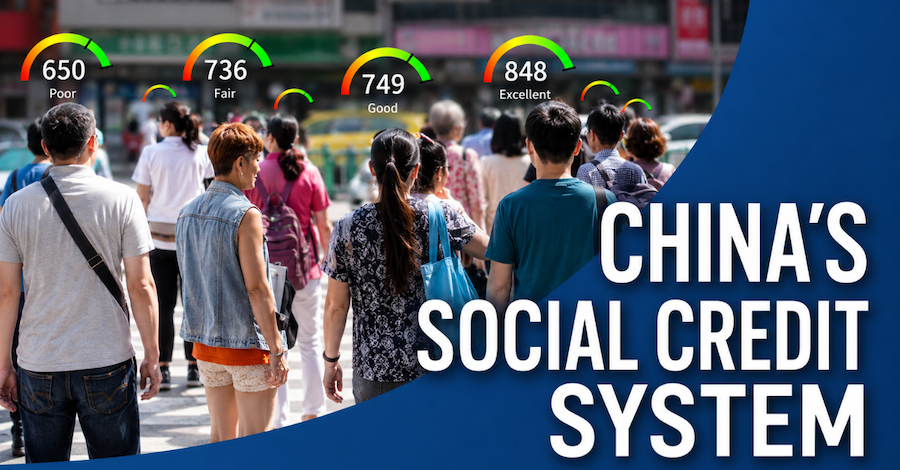
Few topics about contemporary China generate as much confusion as its social credit system. International media often depict it as a national “score” given to every Chinese citizen, influencing access to travel, education, jobs, housing, financial services, and social status. This portrayal is engaging due to its simplicity, drama, and memorability, although it is not completely accurate.
China has a personal credit information system and a broader social credit framework. However, the official system shouldn't be understood as a single public score ranking everyone. Instead, China has developed a large, standardized credit-record infrastructure that integrates financial credit reporting, public legal records, administrative data, judicial enforcement, pilot programs, and policy tools designed to promote what the Chinese government calls it. This distinction is important. A single score implies a straightforward mechanism in which one number defines a person, but the reality is more complex and fragmented. For most individuals, the most tangible aspect is the personal credit report managed by the Credit Reference Center of the People’s Bank of China. This report is primarily used for financial matters, such as loans, credit cards, guarantees, and mortgages, and does not serve as a universal moral ranking.
Meanwhile, the broader social credit system should not be overlooked. It marks a significant shift in how China records credibility, manages risk, and links personal conduct to legal, financial, and administrative outcomes. While the popular narrative may be exaggerated, the system's existence and importance are real.
From Financial Credit to Social Governance
China’s modern social credit framework became a national policy priority in 2014, when the State Council issued the Planning Outline for the Construction of a Social Credit System.
The official objective was to improve trust across government affairs, commerce, society, and the judicial system. In simple terms, China aimed to develop stronger systems that reward trustworthy actions and increase the penalties for serious dishonesty.
The policy emerged from practical problems: as China’s economy expanded, the country faced persistent issues in credit, contract enforcement, food safety, product quality, fraud prevention, tax compliance, enforcement of court judgments, and market regulation. A social credit framework was proposed as a way to reduce information asymmetry, strengthen compliance, and make public records easier to use across institutions.
This is why the system extends beyond personal finance. It touches companies, public institutions, professionals, courts, regulators, and local governments. For individuals, however, the official and most structured part remains the personal credit report. This is the area where the idea of a “personal credit score” is most often misunderstood.
The Official Personal Credit Report
The People’s Bank of China’s Credit Reference Center defines the personal credit report as a part of the country’s financial credit information infrastructure. It aims to document credit behaviors, aid financial decisions, lower information gaps in credit dealings, prevent financial risks, and promote the growth of the credit market.
According to the Credit Reference Center’s official explanation, a personal credit report includes several major categories: basic personal information, credit transaction information, public information, personal statements, dispute notes, and inquiry records. In practical terms, this may include identity-related information, residence and employment information, loan and credit card records, repayment history, overdue debts, guarantee obligations, certain public legal records, and records of institutions that have checked the report.
The core of the report concerns financial behavior. It shows whether a person has borrowed money, used credit cards, guaranteed another person’s debt, repaid on time, or had overdue records. This aligns with the logic of credit-reporting systems used in many other countries. The Chinese system becomes more distinctive because the report can also include certain public information, such as tax arrears, civil judgments, enforcement records, administrative penalties, housing provident fund participation, professional qualification records, and administrative rewards.
This means that personal credit in China is not limited to whether someone has money or debt. It also reflects whether a person has fulfilled certain legal and statutory obligations. In the official language of the Credit Reference Center, the report is intended to objectively record a person’s credit performance and to reflect debt repayment, contract performance, and law-abiding behavior.
The Myth of One Universal Score
The phrase “social credit score” is misleading because it suggests that China has a single official number assigned to every citizen. This is not how the national system is officially structured. Financial institutions may use credit reports, internal scoring models, risk-control systems, and lending policies, but that does not mean there is a universal personal score used across all areas of life.
The Mercator Institute for China Studies, commonly known as MERICS, has directly addressed this point in its analysis of the social credit system. MERICS argues that the idea of every Chinese citizen having a single social credit score is more myth than reality. Instead, the system is better understood as a broad, fragmented framework comprising multiple databases, regulatory mechanisms, local experiments, and enforcement tools.
That does not mean the concerns are unfounded. A fragmented system can still affect people’s lives, especially when financial records, public legal information, administrative penalties, and enforcement lists carry real consequences. The point is that the real concern is not a video-game-style score attached to every citizen. The more realistic concern is the growing use of data and public records to define trustworthiness in financial, legal, and administrative contexts.
This distinction is essential to any serious discussion of the topic. The exaggerated version may be easier to communicate, but the real system is more complex and, in some ways, more significant because it is embedded in ordinary institutional procedures rather than presented as a single, visible number.
The Data Inside the Credit Report
A personal credit report in China includes both positive and negative information. Positive information can show that a person has borrowed responsibly, repaid on time, and maintained a reliable credit history. Negative information may include overdue loan payments, unpaid credit card balances, defaults, guarantee-related liabilities, and other records indicating that obligations were not fulfilled.
The Credit Reference Center explains that credit transaction information is the core content of the report. It includes current liabilities, repayment history over recent years, contingent liabilities, and credit facilities obtained by the individual. The report may also show recent inquiry records, including checks made for loan, credit card, and financing approvals, guarantee qualification reviews, insurance reviews, and personal inquiries.
The public information section is especially important because it broadens the meaning of credit. Official materials list public information categories such as tax arrears, civil judgments, compulsory enforcement records, administrative penalties and rewards, housing provident fund records, subsistence allowance records, and professional qualification records. This shows how China’s personal credit architecture links financial credibility with legal and administrative conduct.
In daily life, this means that a person’s credit record can become relevant before a major financial decision. Applying for a mortgage, requesting a consumer loan, obtaining a credit card, or acting as a guarantor may involve a review of credit information. A clean record can support trust, while a negative record can increase scrutiny or reduce access to credit.
The Five-Year Retention Rule
One important official rule concerns the treatment of negative information. The Credit Reference Center states that adverse information in a personal credit report is retained for five years from the date the adverse behavior or event ends. Positive information, by contrast, is treated as part of a person’s credit wealth and continues to be displayed.
This five-year rule is important because it prevents many negative records from becoming permanent. If a person has an overdue debt and later repays it, the relevant negative information is generally retained for a defined period rather than remaining indefinitely. In practical terms, solving the problem matters because the retention period is tied to the end of the negative behavior or event.
The rule also changes how individuals should approach personal credit management. Ignoring a debt does not make the problem disappear. Correcting the issue, repaying what is owed, and maintaining better future credit behavior are the practical steps that allow a negative record to age out under the official framework.
Personal Rights and Dispute Procedures
China’s personal credit system also includes formal rights for individuals. The Credit Reference Center states that individuals have the right to know their credit status, raise disputes, file complaints, and bring legal action if their rights are harmed. This matters because credit information can affect access to loans and other financial services.
Individuals can check their credit reports through several official channels. These include local branches of the People’s Bank of China, self-service inquiry machines, the Credit Reference Center’s official website, authorized commercial-bank online banking systems, mobile banking apps, smart teller machines, and the UnionPay Cloud QuickPass app. The Credit Reference Center also states that individuals are entitled to two free personal credit report inquiries per year. From the third inquiry onward, a fee may apply.
If a person believes that information in the report is incorrect or incomplete, they may submit a dispute to the relevant People’s Bank of China branch or to the institution that provided the information. The official process requires an investigation and a written response within the prescribed period. If the information is confirmed to be incorrect or incomplete, it should be corrected. If the issue cannot be fully confirmed, the report can include a record of the dispute.
These procedures do not eliminate all concerns about fairness, but they show that the official personal credit-reporting system is not designed as an unchallengeable black box. Accuracy, correction, and dispute rights are part of the formal structure.
Credit Repair and the 2026 Update
A significant recent update involves credit repair. In December 2025, China's People’s Bank announced a one-time policy to repair specific negative credit records. Official reports state that overdue debts from 2020 to 2025, with a single overdue amount under RMB 10,000, could be removed from credit reports if fully repaid by March 31, 2026.
The Credit Reference Center later published a 2026 FAQ stating that the policy is “automatic and application-free” for eligible cases. Individuals do not need to submit materials, hire an intermediary, or pay any third party. The credit system identifies and processes eligible overdue information in accordance with the policy’s conditions.
This update is important because it shows that China’s personal credit system is not only punitive. It also contains mechanisms for restoring credit records under defined conditions. However, the policy does not mean that all bad records can be erased, nor does it mean that credit discipline has been relaxed. It applies only to eligible records and under specific conditions.
The FAQ emphasizes that even if an overdue record is fixed or no longer visible, it doesn't automatically guarantee a loan. Financial institutions continue to evaluate multiple factors such as assets, income, credit history, repayment ability, risk appetite, and internal lending policies when making credit decisions. Therefore, while personal credit reports are significant, they are not the sole consideration.
The Rise of Credit Repair Scams
The same official materials strongly warn against “credit repair” scams. The Credit Reference Center has stated that it does not provide services to delete overdue records, close non-compliant online loan accounts, or clean credit history through special channels. It has also warned that anyone claiming to “wash” or “clean” a credit report for money is likely committing fraud.
This warning is relevant because credit anxiety fuels a market for deception. Fraudsters may pretend to have internal access, promise to remove large overdue records, ask users to share screens, collect sensitive personal information, or push people into new borrowing under the guise of “debt optimization.” The official advice is clear: if a record is accurate, the individual should repay the debt and rebuild credit behavior; if a record is incorrect, the individual should use the official dispute process.
For readers, this is one of the most practical points in the topic. The personal credit system can affect real financial opportunities, but unofficial credit-cleansing services create additional risk. The safest route is through official channels.
Public Opinion and Research Findings
Public perception of social credit inside China is more complicated than the international debate suggests. A study discussed by MERICS and conducted among 2,209 Chinese citizens between February and April 2018 found high levels of approval among internet-connected respondents aged 14 to 65. According to the study, 80 percent of respondents either somewhat approved or strongly approved of social credit systems, while 19 percent were neutral and only 1 percent expressed moderate or strong disapproval.
The research revealed that commercial rating systems are far more known than local government pilots. Over 80 percent of respondents reported using a commercial pilot, with Sesame Credit being the most popular, while only 7 percent knew they were part of a local government pilot. Among those living in one of the 42 localities with a government pilot, just 11 percent were aware of their participation.
These numbers help clarify why the term “social credit” often causes confusion. Many people associate it with commercial services offering convenience benefits—like deposit-free transactions, faster procedures, or lifestyle features based on credit. Others link it to government records, administrative oversight, or judicial enforcement. International observers might imagine a centralized state score. While related, these are not the same.
The study also found support was generally stronger among wealthier, better-educated, urban respondents, partly because they are more likely to benefit from convenience-driven credit services. However, future public support depends significantly on transparency and fairness. If people do not understand how assessments are made, or face unfair outcomes, support could decrease.
The 2025 Policy Direction
The latest official policy direction indicates that China is working to standardize the social credit system. In March 2025, the State Council issued a new guideline to improve the system. The guideline included 23 measures and emphasized unified rules, a fair market order, information security, and the protection of individual rights.
This update is significant because it directly addresses some of the risks that have surrounded the system: inconsistent local rules, insufficient sharing and openness of credit information, excessive information collection, and improper disclosure or use of data. The National Development and Reform Commission stated that the construction of the social credit system must protect information security and individual rights while guarding against excessive collection and illegal or irregular processing, disclosure, sale, or use of information.
This does not mean that all concerns disappear. Implementation will matter more than policy language. But the 2025 direction shows that the system is entering a phase of standardization rather than remaining only a collection of local experiments and fragmented rules.
The Real Impact on Daily Life
For most individuals, the personal credit system plays a crucial role in everyday financial matters. It can determine eligibility for a mortgage, consumer loans, credit cards, acting as a guarantor, or obtaining favorable credit terms. A solid credit history often facilitates access to financial services, whereas a poor record may lead to delays, increased scrutiny, or outright rejection.
More serious consequences tend to occur when credit issues intersect with legal enforcement. Someone who fails to comply with a court judgment may face restrictions linked to enforcement processes. These situations differ from typical late payments, as they involve legal obligations already validated through judicial channels.
Therefore, understanding the system requires avoiding two mistakes: first, thinking a single national score governs every citizen’s life; second, believing the system has no practical impact. The truth lies between these extremes. China’s personal credit setup is not a universal public ranking, but credit records, public info, and enforcement tools can significantly influence real-world opportunities.
A More Accurate Way to Understand the System
China’s personal credit system functions as a trust infrastructure based on records. It’s more than just a score or a financial database; it’s a developing network that ties together repayment history, legal data, risk assessments, personal rights, dispute procedures, and policy measures to formally define trustworthiness.
While the phrase “social credit score” grabs attention, it often obscures the actual structure. The official personal credit report resembles a financial credit record, but the broader social credit system extends further. It is more fragmented, connected to governance, and influenced by local pilots and commercial platforms.
The key takeaway is straightforward:
In China, personal credit increasingly shapes a person’s financial and institutional identity. It indicates whether obligations are fulfilled, debts are repaid, public records are in order, and institutional data is accurate.
For international audiences, the central point is to avoid oversimplification. The system should be understood neither by the negative portrayals often found overseas nor merely as a bureaucratic administrative tool. Instead, it represents a significant effort to use data, records, and regulation as instruments for building trust in a modern society.